Top Solar Panel Solutions for Sustainable Energy Use Today?
As global awareness of environmental issues grows, solar panel solutions have become essential. These technologies help reduce our carbon footprint and offer sustainable energy. Today, many options exist that cater to different needs and budgets. Choosing the right solar panels can seem overwhelming.
Some products boast high efficiency, while others claim affordability. However, not all solutions are equal. Factors like location, building design, and energy needs play a significant role. It's essential to consider these elements when evaluating solar panel options. Many consumers still overlook these details.
In this rapidly evolving market, ongoing improvements continue to emerge. While some solutions are impressive, others might not live up to the hype. Adjusting expectations based on personal circumstances can lead to better decisions. Understanding solar panel solutions is crucial for everyone looking to invest in renewable energy.

Overview of Renewable Energy Trends in the Solar Industry
The solar industry is rapidly evolving. New technologies are emerging, enabling more efficient energy capture. Solar panels now come with better designs and materials. This makes them more accessible for consumers and businesses alike. Many people are investing in solar energy as a sustainable option. The trend is clear: cleaner energy is in demand.
There are some challenges, though. Not every location is ideal for solar panels. Weather conditions can dramatically impact efficiency. Additionally, the initial costs can be a barrier. Many homeowners hesitate, worrying about return on investment. This highlights a need for better education on the long-term benefits of solar energy.
In recent years, community solar projects have gained traction. These allow people to invest collectively in solar power. It's a practical way for those unable to install panels at home. Awareness of these options is still low. Many potential users are unaware of the opportunities available. This gap needs to be addressed to harness the full potential of solar energy.
Top Solar Panel Solutions for Sustainable Energy Use Today
| Solar Panel Type |
Efficiency (%) |
Wattage (W) |
Average Cost ($/W) |
Lifespan (years) |
| Monocrystalline |
20-22 |
300-400 |
0.80-1.00 |
25 |
| Polycrystalline |
15-20 |
250-350 |
0.70-0.90 |
20 |
| Thin-Film |
10-12 |
100-200 |
0.60-0.80 |
15 |
| Bifacial |
20-25 |
350-450 |
0.90-1.10 |
30 |
Key Technological Innovations in Solar Panel Efficiency and Production
As we explore solar panel innovations, efficiency emerges as a key focus. Recent advancements have improved energy conversion rates, allowing panels to capture more sunlight. This is crucial for maximizing energy output. Some panels can now convert over 23% of sunlight into usable electricity. However, this improvement raises questions about the environmental impact of manufacturing processes.
The production of solar panels has become more sustainable. New materials are being developed that reduce waste and enhance durability. For instance, some panels are made using less toxic elements, which is a step forward. Yet, the process still generates significant waste. Recycling options for old panels are limited. This poses a challenge for the industry.
Moreover, innovations in technology are constantly evolving. Bifacial solar panels are gaining popularity. They can capture light from both sides, increasing efficiency. However, they also come with a higher price tag. Affordability remains a significant barrier for widespread adoption. It's essential to balance cost and efficiency to drive growth in the solar energy sector.
Solar Panel Efficiency and Production Innovations
This chart illustrates the improvements in solar panel efficiency and production technologies over the years, focusing on key innovations that have enhanced the sustainability of energy use.
Market Analysis: Global Solar Energy Adoption Rates and Projections
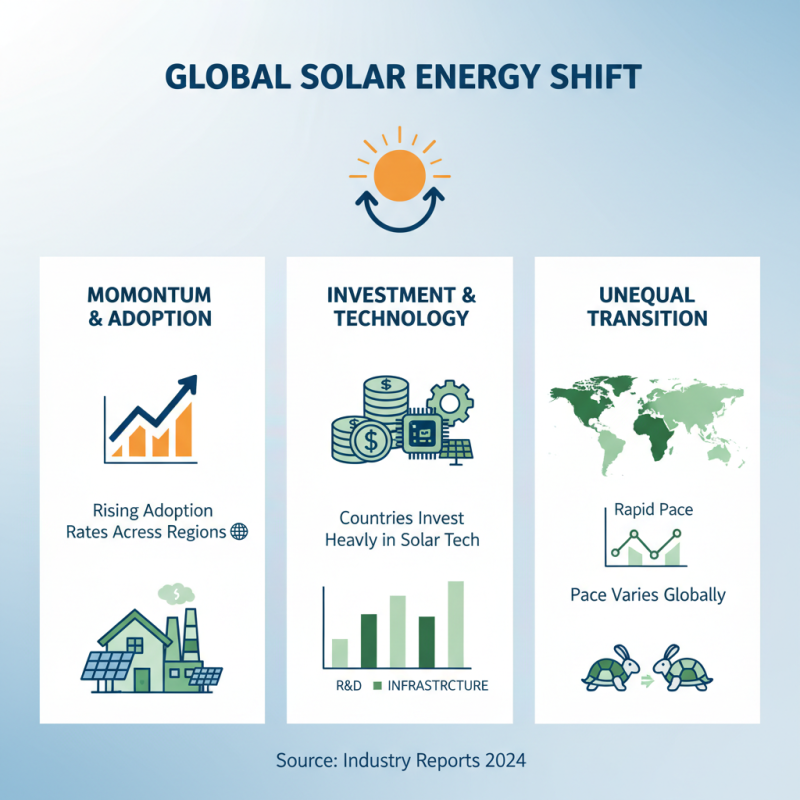
The global shift towards solar energy is gaining momentum. Adoption rates are increasing across various regions. Many countries are investing heavily in solar technologies. However, the pace of this transition is not uniform worldwide.
In some areas, adoption is remarkable. For instance, some developing countries harness solar power to address energy shortages. In contrast, established economies may face resistance due to infrastructure or political reasons. This discrepancy is noteworthy. Many initiatives fail to account for unique local challenges.
Projections suggest a bright future for solar energy. However, reliance on projections must be tempered with caution. Existing forecasts may overlook important variables, such as policy changes or economic downturns. As solar technology evolves, so do market trends. Adapting to these changes can be challenging for businesses and consumers alike.
Comparative Study of Solar Panel Types: Monocrystalline vs. Polycrystalline
When choosing solar panels, two primary types stand out:
monocrystalline and polycrystalline.
Monocrystalline panels are known for their efficiency and sleek design.
They convert more sunlight into energy, with efficiency rates around 15-22%.
This makes them ideal for limited roof space. They also last longer due to higher quality silicon.
However, they tend to be more expensive.
Polycrystalline panels, on the other hand, are often more affordable.
They have slightly lower efficiency rates, typically around 13-16%.
This means they require more space for the same power output.
The manufacturing process is simpler and generates less waste, which is environmentally friendly.
Despite their lower efficiency, they remain a popular choice for many homeowners.
Data from the International Energy Agency shows that solar energy could become the world's largest source of electricity by 2030.
As availability increases, consumers face challenging decisions.
Which type is best for their specific needs?
Monocrystalline offers performance;
polycrystalline brings cost savings.
Preferences vary, indicating there is no perfect solution.
Solar technology continues to evolve, and understanding these nuances helps in making informed choices.