Top 10 Solar Panels to Source at 2026 China Import Export Fair?
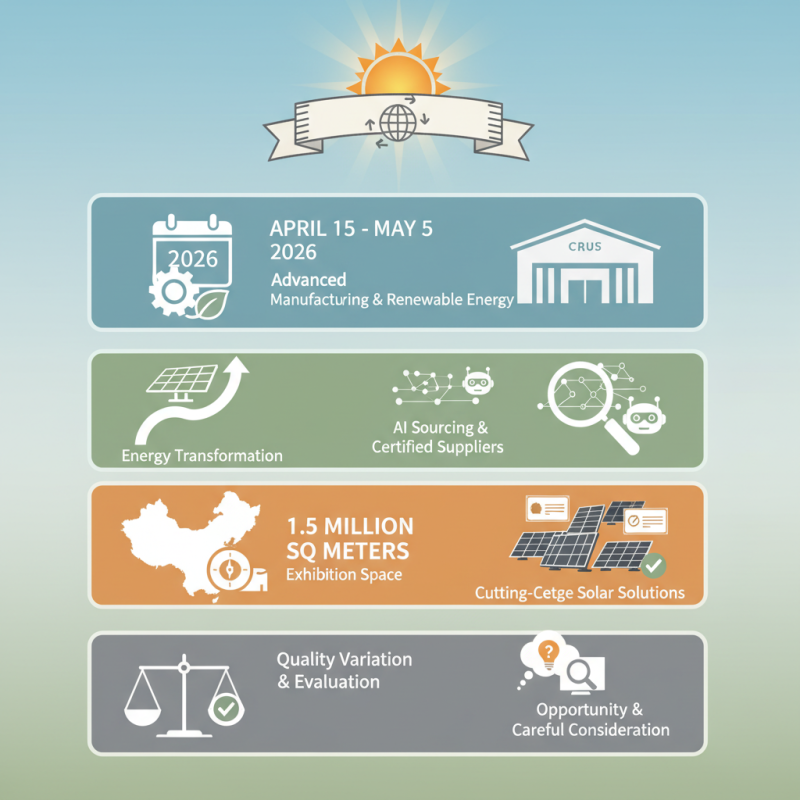
The 2026 China Import Export Fair, also known as the Canton Fair, offers a unique platform for sourcing Solar Panels. Scheduled from April 15 to May 5, the fair showcases the latest in advanced manufacturing and renewable energy technologies. With a focus on innovation, it attracts suppliers and buyers worldwide, highlighting the importance of sustainable solutions.
As businesses seek environmentally friendly options, solar panels play a crucial role in energy transformation. The fair's AI features streamline the search for certified suppliers, enhancing efficiency in sourcing quality products. Buyers can navigate over 1.5 million square meters of exhibition space to discover cutting-edge solar panel solutions that meet international standards.
However, not all solar products will meet expectations. Quality variations can occur, leading to potential challenges in energy production. It’s essential for buyers to conduct thorough evaluations before making decisions. The Canton Fair is a place for both opportunity and reflection, encouraging careful consideration in the pursuit of solar panel technology.
Top Trends in Solar Panel Technology for 2026 Import Export Fair
As the 2026 China Import Export Fair approaches, solar panel technology trends are evolving rapidly. Innovations in efficiency and sustainability are shaping the future of the industry. Recent reports suggest that by 2025, solar panel efficiency could reach unprecedented levels, with some models achieving over 25%. This is a significant leap that could alter market dynamics.
Additionally, there's a growing emphasis on bifacial solar panels. These panels generate energy from both sides, enhancing overall efficiency in various lighting conditions. In urban settings, where space is limited, this technology could prove revolutionary. Reports indicate that bifacial panels could increase energy generation by 10-20% compared to traditional panels.
Tip: Consider the environmental impact of your solar panel choice. Look for products made from recyclable materials.
Another notable trend is energy storage integration. Many manufacturers are focusing on solar panels that work seamlessly with battery systems. This integration ensures a consistent power supply, making solar energy more reliable. However, the challenge lies in the higher initial investment costs.
Tip: Review long-term savings versus initial costs. A higher upfront expenditure might offer better returns.
As these technologies develop, potential buyers should remain informed. The landscape is continually shifting, and what works today may not be optimal tomorrow. Keeping an eye on these advancements will be crucial for making smart purchasing decisions at the fair.
Market Insights: Growth Projections for Solar Panel Industry by 2026
The solar panel industry is projected to witness significant growth by 2026. According to a report by Global Market Insights, the market size is expected to reach $200 billion. This represents a compound annual growth rate (CAGR) of around 20% over the next few years. Factors contributing to this growth include technological advancements and increasing government support for renewable energy initiatives.
However, challenges remain. The supply chain for raw materials is under pressure. This could impact the availability of high-quality solar panels. Moreover, fluctuating prices of polysilicon, a key ingredient, may pose risks. Even with these hurdles, the industry remains optimistic about reaching its goals. Innovations in solar technology, such as bifacial modules, are emerging as potential game-changers. They promise higher energy yields and efficiency.
Regional dynamics also play a role. Asia-Pacific is currently the largest market, but growth is expected everywhere. North America and Europe are ramping up investments in solar projects. Ideally, this will drive demand. The path forward may not be smooth, but the outlook is promising. Focusing on quality and sustainability will be essential to seizing opportunities in this vibrant market.
Sustainability Standards: Eco-Friendly Certifications for Solar Panels
Eco-friendly certifications for solar panels are essential in today's market. Renewable energy demands sustainable practices. The International Renewable Energy Agency (IRENA) reports that solar power could contribute up to 30% of global electricity by 2030. This growth encourages manufacturers to adopt environmentally friendly standards.
Companies are increasingly pursuing certifications like ISO 14001 and the Energy Star label. Such certifications highlight a commitment to reducing carbon footprints. However, compliance can be complex. Many manufacturers struggle with the rigorous requirements. A recent study found that only 45% of solar panel producers meet international sustainability standards.
Data shows consumers prefer certified products. A survey indicated that 75% of buyers consider eco-friendly certifications as vital. This trend pushes manufacturers to improve their sustainability efforts. Yet, not all panels labeled green are verifiably sustainable. This inconsistency leads to skepticism among buyers. Transparency in the certification process is essential to build trust.
Comparative Analysis: Efficiency Ratings of Top Solar Panel Brands
The 2026 China Import Export Fair will showcase a variety of solar panels. Understanding efficiency ratings is crucial when choosing the right product. Efficiency determines how much sunlight is converted into electricity. Higher ratings often mean better performance and value over time.
When evaluating solar panels, several factors can influence their efficiency. Cell design and materials play a key role. Some panels may look sleek but lack performance. It’s important to look beyond aesthetics. Additionally, temperature coefficient ratings indicate how a panel performs in heat. This feature is often overlooked but essential in warmer climates.
Tips: Always compare multiple options before purchasing. Read reviews and check independent tests. Take your time. Quality is more important than speed in your decision-making process. Consider installation processes, too; simple setups can save money.
Remember, efficiency isn’t everything. Sometimes, lower-rated panels perform well under specific conditions. Assess your unique needs. Create a shortlist and don’t rush. Each choice should reflect both performance and your energy goals.
Top 10 Solar Panels Efficiency Ratings
This chart illustrates the efficiency ratings of the top 10 solar panels based on recent data. Higher efficiency ratings indicate better performance in converting sunlight into usable electricity, which is a crucial factor for consumers and businesses when choosing solar panels.
Cost-Benefit Analysis: Investment Value of Solar Panels in 2026
The investment value of solar panels in 2026 is significant. According to recent industry reports, the global solar market is expected to grow at a compound annual growth rate (CAGR) of about 20%. This growth reflects a rising demand due to concerns about climate change and energy efficiency. Many are opting for solar energy to reduce their carbon footprint.
Evaluating cost benefits can be complex. The average cost of solar panels has decreased by 50% over the last decade. However, installation and maintenance costs can vary widely. A report by the International Renewable Energy Agency indicates the payback period can be as short as five years in regions with abundant sunshine. Nevertheless, some regions face longer payback periods due to high installation costs and lower sunlight exposure.
Investors should consider local policies. Incentives like tax credits and rebates can significantly impact overall savings. Some markets lack supportive policies, making solar less attractive. Evaluating potential risks and benefits is crucial. The solar panel market offers promising returns, but challenges persist. Balancing investment with practical considerations leads to more informed decisions.
Top 10 Solar Panels to Source at 2026 China Import Export Fair | Rank | Panel Type | Efficiency (%) | Cost per Watt (USD) | Warranty (Years) | Estimated ROI (%) |
| 1 | Monocrystalline | 22.5 | 0.30 | 25 | 20 |
| 2 | Polycrystalline | 20.0 | 0.25 | 25 | 18 |
| 3 | Bifacial | 23.0 | 0.35 | 30 | 25 |
| 4 | Thin-film | 15.0 | 0.18 | 10 | 10 |
| 5 | PERC | 21.5 | 0.28 | 25 | 19 |
| 6 | Half-cell | 21.0 | 0.32 | 25 | 21 |
| 7 | Building-integrated | 18.0 | 0.40 | 20 | 15 |
| 8 | Smart solar panels | 22.0 | 0.33 | 25 | 22 |
| 9 | Agrovoltaics | 20.5 | 0.38 | 30 | 20 |
| 10 | Concentrated PV | 27.0 | 0.50 | 25 | 30 |